The District of Columbia is known for the U.S. Capitol, White House, National Mall, Smithsonian museums, major memorials and its role as the seat of the federal government. It is not a U.S. state; Washington, D.C. is a federal district created to serve as the national capital.
Government landmarks are only one part of the experience. Beyond the Mall, visitors find historic neighborhoods, universities, theaters, restaurants, embassies and a strong local culture. The city is compact and has a useful Metro system, making it easier to explore without a car than many American destinations.
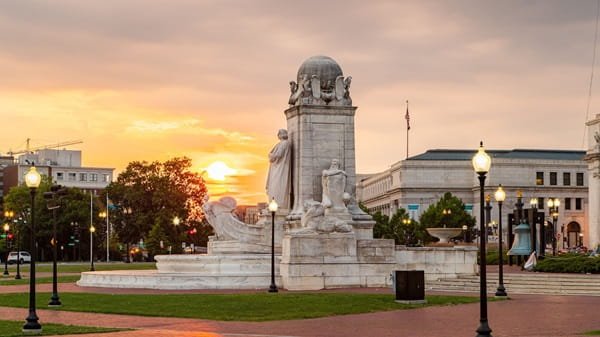
District of Columbia at a Glance
| Detail | Information |
| Location | Federal district on the Potomac River between Maryland and Virginia |
| Capital | Washington, D.C. is the capital of the United States |
| Nickname | Commonly called Washington, D.C. or the District |
| Major visitor draws | National Mall, Smithsonian museums, U.S. government landmarks, monuments, neighborhoods, history and international culture |
1. The National Mall and Major Memorials
The National Mall is the ceremonial heart of Washington, linking the U.S. Capitol with the Washington Monument, Lincoln Memorial and major museums. Its open lawns and memorials tell stories about war, civil rights, presidents and national memory. Walking distances on the Mall are longer than they appear, so comfortable shoes and a realistic museum schedule make a noticeable difference.
- Lincoln Memorial: One of the capital’s most recognizable monuments and the setting for major civil-rights history.
- Washington Monument: The tall obelisk dominates the central Mall skyline.
- Vietnam Veterans and Korean War memorials: Provide more personal forms of remembrance within the larger monumental landscape.
2. Smithsonian Museums
Washington is famous for museums, many of them part of the Smithsonian Institution. Several major Smithsonian museums have free general admission, which makes it possible to build a full day around history, science, art or culture without a large ticket budget. Because the collections are enormous, choosing two or three museums by interest is usually more satisfying than trying to enter every building in one day.
- National Air and Space Museum: Focuses on aviation, spaceflight and exploration.
- National Museum of African American History and Culture: Explores African American history and its central place in the American story.
- National Museum of Natural History: Known for fossils, minerals, human origins and natural-science collections.
3. The U.S. Capitol and Federal Government
Washington’s public buildings make the workings of the federal government visible in a way no other U.S. city can match. The Capitol, Supreme Court and executive branch landmarks are all within a relatively small area. Public demonstrations, congressional activity and security needs can temporarily change street access around federal buildings.
- S. Capitol: Home of Congress and a major architectural landmark at the eastern end of the National Mall.
- Supreme Court: Located across from the Capitol and associated with the judicial branch of the federal government.
- Government visits: Tours and public access rules vary, so check official procedures rather than assuming walk-in entry.
4. The White House and Presidential History
The White House is both a working residence and one of the most recognized symbols of the United States. The surrounding area also contains historic buildings, public parks and institutions connected with presidential and diplomatic history. The White House itself is smaller than many first-time visitors expect, especially when seen among the larger government buildings nearby.
- Lafayette Square: Provides one of the familiar public views toward the White House.
- White House Visitor Center: Offers exhibits about the building, its residents and its history without requiring a White House tour.
- Presidential sites: Additional museums and monuments across the city place individual administrations in broader historical context.
5. Historic Neighborhoods Beyond the Mall
Washington is a city of neighborhoods, not simply a government campus. Row houses, markets, waterfront districts and commercial streets reveal everyday local life beyond the monumental core. Neighborhood restaurants and local businesses are also where visitors are most likely to encounter Washington as a lived-in city rather than a national symbol.
- Georgetown: Known for historic architecture, the C&O Canal, shopping and a waterfront setting.
- Capitol Hill: A residential neighborhood with Eastern Market, row houses and close proximity to Congress.
- Adams Morgan and U Street: Known for restaurants, nightlife, music history and diverse community life.
6. Civil Rights and African American History
Washington has played a central role in national civil-rights history and has long been home to a large and influential Black community. Museums, churches, universities, memorials and performance venues preserve this story across the city. Sites such as the African American Civil War Memorial and historic churches add important local layers to the national story told on the Mall.
- Martin Luther King Jr. Memorial: Honors the civil-rights leader beside the Tidal Basin.
- U Street: Historically associated with Black businesses, theaters and jazz culture.
- Howard University: A historically Black university with major importance in education, politics and civil-rights history.
7. Cherry Blossoms and the Tidal Basin
Spring cherry blossoms are one of Washington’s most photographed seasonal attractions. Thousands of visitors gather around the Tidal Basin and nearby parks when the trees bloom, though exact timing changes with weather each year.
- Tidal Basin: A scenic loop near the Jefferson, Franklin Delano Roosevelt and Martin Luther King Jr. memorials.
- Peak bloom: Cannot be fixed far in advance, so use current National Park Service updates when planning a spring trip.
- Crowds: Early morning visits can make popular blossom areas easier to enjoy.
8. International Food, Embassies and Culture
As a national capital, Washington attracts diplomats, students and residents from around the world. That international character is visible in embassy events, restaurants, museums and neighborhoods across the District.
- Embassy Row: Concentrates diplomatic buildings along and near Massachusetts Avenue.
- Food scene: Ethiopian, Salvadoran, Korean, Middle Eastern and many other cuisines are part of everyday Washington dining.
- Kennedy Center and theaters: Major performing-arts institutions add another layer beyond political tourism.
Frequently Asked Questions
Q. Is the District of Columbia a state?
No. Washington, D.C. is a federal district and the capital of the United States. It has its own local government but does not have the same constitutional status as a state.
Q. Do I need a car in Washington, D.C.?
Usually not for a typical sightseeing trip. The Metro, buses, walking and rideshare services cover most major visitor areas, while parking can be expensive and inconvenient near downtown attractions.
Q. Are Smithsonian museums free?
Many Smithsonian museums in Washington offer free general admission, though some popular museums or special experiences may use timed-entry passes. Check the museum’s current visitor page before arrival.
Q. How many days are enough for a first visit?
Three to four full days allow time for the National Mall, several museums and at least one neighborhood beyond downtown. Museum-heavy travelers can easily stay longer.
Q. Can I tour the White House or U.S. Capitol?
Public tours are possible under specific procedures, but access rules differ and can change. Use the official White House and U.S. Capitol visitor information well in advance rather than relying on third-party claims.